English
 Tiếng Việt
At 24, entering university, what did Do Xuan Thanh bring with him from his two years in the military?



At the age of 24, when many of his peers had already graduated from university and started working, Do Xuan Thanh was just entering university. Born in 2002, Thanh is currently a student in class TCNH 18-02, Faculty of Finance and Banking, Dai Nam University, studying alongside friends born in 2006. But Thanh didn't start university empty-handed. Two years of military service have become an integral part of his preparation: discipline, responsibility, team spirit, and above all, maturity to know what he wants and to be serious about his choices.
The four-year age difference initially made Thanh somewhat hesitant. But before becoming a student, he had spent two years living in an environment very different from the classroom – where schedules, discipline, tasks, and responsibilities to the group were a part of daily life.
Those two years didn't get Thanh to university any sooner, but they helped him return with a different kind of preparation.

Do Xuan Thanh entered university at the age of 24.
FROM SOMEONE WHO DIDN'T KNOW WHAT THEY WANTED
After graduating from high school, Thanh didn't choose a university right away. At that time, he hadn't clearly decided what major he wanted to study or what kind of job he wanted to do in the future.
"I also thought about going to university, but at that time I didn't really know what I wanted. I think if I hadn't determined my direction and chose a major right away, it would be easy to follow my friends or choose a major just because many people were studying it."
Instead of immediately entering a field of study without a clear direction, Thanh fulfilled his military service.
As a young man fresh out of high school, Thanh entered a completely different rhythm of life. Every activity had a schedule; every task had specific requirements; a person's work was not just their own responsibility, because individual responsibility was always linked to the collective.
“There were things I could do before according to my own convenience, but that’s not possible in the military. Punctuality, adherence to regulations, and completing tasks are mandatory. When assigned a task, you have to be proactive and complete it within the allotted time, because if one person is late or fails to complete it, it can affect the entire team.”
That was perhaps one of the most significant changes that the military environment left in Thanh.
Discipline is not just about waking up on time or following a strict schedule. After spending enough time living in a group, young people gradually understand that every action they take comes with responsibility.
Thành recounted: “Before, I thought a small task could be done anytime. After two years, I understand that each person's time and responsibility are linked to those around them. When you receive a task, you must try your best to complete it, because behind your work is a team.”
From what seemed like a small incident, Thanh learned something much bigger: don't be careless with your responsibilities, because one person's carelessness can sometimes become a problem for others.
Two years in the military also gave Thanh time to reflect on the path ahead.
"Before enlisting, I didn't really know what I wanted. After two years in the military, I realized I needed specialized knowledge and a clearer direction for the future."
After completing his military service, Thanh decided to return to university and chose to major in Finance and Banking.

After two years in the military, Do Xuan Thanh proactively integrated into the group and actively participated in activities at Dai Nam University.
While previously university was just one possibility among many options, this time, Thanh entered university after gaining two more years of experience to better understand the value of time, responsibility, and the need to choose his own path.
Two years in the military not only shaped Thanh's way of life, but more importantly, it contributed to shaping how a young person perceives responsibility for their own life.
BRINGING MILITARY DISCIPLINE INTO THE CLASSROOM
When Thành returned to school, he was 24 years old.
Most of his classmates were born in 2006. Four years old at that time was enough for Thanh to feel a little different.
"At first, I was a little hesitant because my classmates were four years younger than me. But they were very open. When we studied together and participated in activities, I realized that age was no longer a barrier. I just proactively integrated and did my part well."
Thành didn't choose to stand aside just because he was older. He studied with his classmates, participated in group activities, and took on his share of responsibility within the group.
Not long after, Thanh was entrusted by his classmates with the position of Class Deputy for Student Life in the TCNH 18-02 class.
A new environment, a new responsibility, but the way Thanh views the task he's been given clearly reflects how he did two years prior.
"Once I've accepted a task, I'm conscious of the need to see it through to the end and try not to negatively impact the team. This is also an opportunity for me to continue developing myself in a different way."
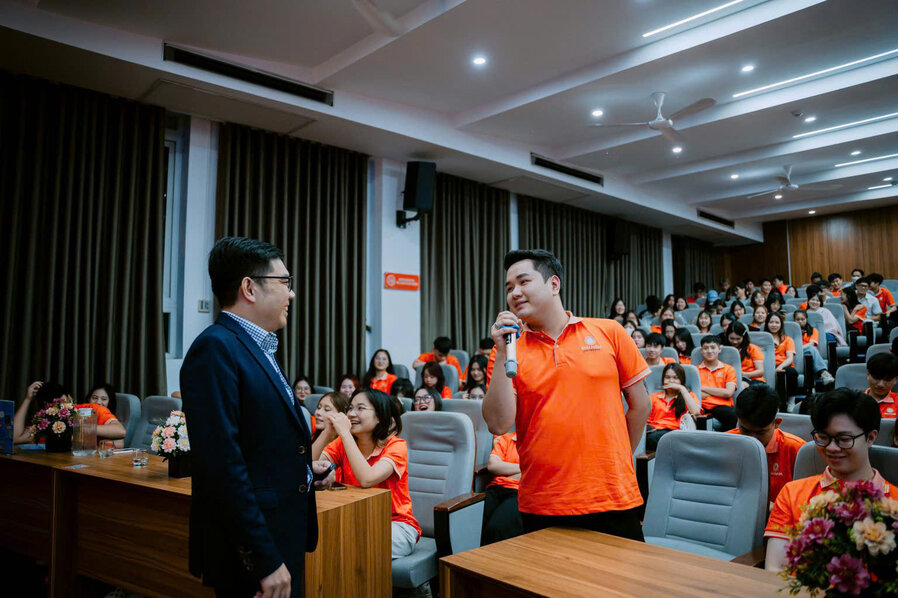
The military and the university are two very different environments. But there are qualities that are valuable in both environments.
Be punctual. Maintain discipline. Take responsibility for the tasks you undertake. Do not let personal convenience negatively impact the team. Know how to cooperate with those around you. And when faced with an unfavorable situation, first try to adapt instead of standing idly by.
Two years in the military didn't give Thanh a special position when he entered university. But what he learned during those two years is helping him develop a different approach to his studies and collective responsibilities.
Even the four-year age gap with his peers was handled by Thanh in a rather simple way: proactively integrating and doing his part well.
Perhaps that's also a sign of maturity.
Instead of demanding that the environment change to suit oneself, one should first learn to adapt oneself to become a positive part of the new environment.
NOT STARTING SOONER, BUT STARTING MORE CLEARLY
After two years in the military, the noticeable changes in Thanh were not just in his lifestyle or how he received assignments.
That's also how I view learning.
"Now I no longer think of studying simply to get a degree. I want to know what I need to be good at, what skills I need to improve, and how I need to prepare so that I can find a job after graduation."
At the age of 24, Thanh entered university having come to understand that time is valuable and that every choice comes with responsibility.
At Dai Nam University, I continued to study Finance and Banking, honing my skills and preparing for my future career. My classmates, four years younger than me, welcomed me as a member of the class; and the group entrusted me with the responsibility of being the Deputy Class Representative for Student Affairs.
Someone who once didn't know what they wanted is now gradually defining what they need to prepare for the future.
"Starting university at 24 might be later than many of my peers, but I don't think I'm starting too late. What's important is knowing what you're choosing and being serious about that choice."
Therefore, Do Xuan Thanh's story should not be viewed as the story of a student who "arrives late for class."
Because each young person may have a different journey. Some go straight from high school to university. Some work first and then return to school. And there are also young people who spend the best years of their youth fulfilling their military service before continuing their education.
Serving in the military is not a step away from the journey of growing up. It can even be an important part of that journey.
Two years in the military might cause a young person to enter university later than their peers. But in return, if they truly live and train in that environment, they can gain invaluable things: discipline, endurance, adaptability, teamwork, a sense of responsibility, and maturity in their self-perception.
Those are qualities needed not only for a soldier.

The classroom needs those qualities. Businesses will need those qualities later on. And over the longer journey of life, each person's life will need those qualities even more.
Therefore, for young people preparing to enlist in the military, and for families with children already serving, those two years should perhaps not be measured solely by the question: "How many years behind will my child be compared to their peers?"
There's another question worth asking: "After those two years, what kind of person will you come back as?"
Do Xuan Thanh returned to university at the age of 24. He didn't return with two years of military service behind him. He carried with him the skills and experience honed during those two years, ready to embark on a new journey: learning a trade, taking responsibility for his group, and preparing for the future with a clearer mindset.
There are paths we may not take to progress faster than others, but they help us become more steadfast on our own journey. For Thanh, his two years in the military were one such path.
BTT