English
 Tiếng Việt
Dr. Le Dac Son: The lasting happiness of young people does not come from a beautiful diploma.



"The lasting happiness of young people doesn't come from a prestigious degree, but from the confidence to stand firm on their own two feet in the face of life's challenges."
At the seminar "Creating Happy Universities in Vietnam: From Vision to Action," co-organized by Dai Nam University and Soha.vn on May 22nd, Dr. Le Dac Son, Chairman of the University Council of Dai Nam University, shared insightful perspectives on the philosophy and model for building happy universities.
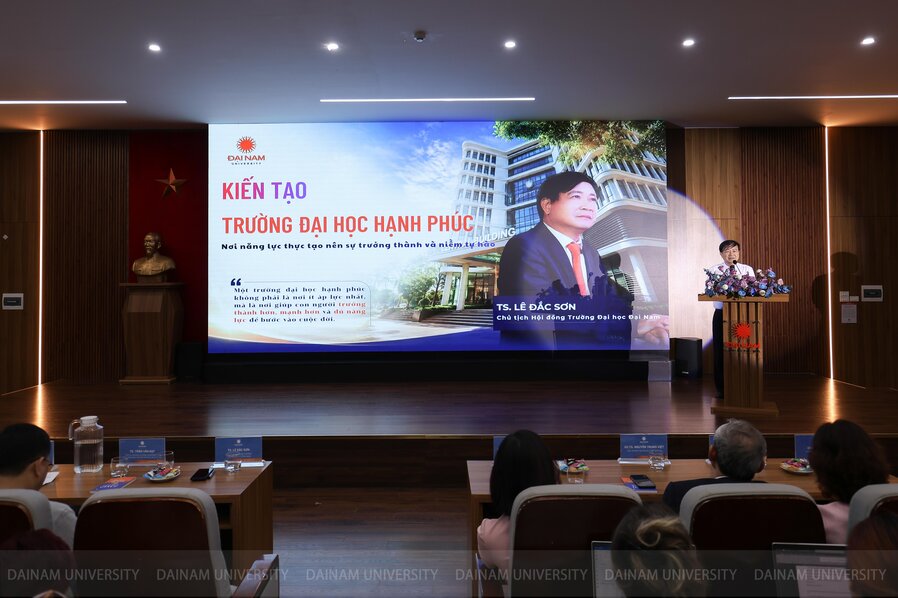
Dr. Le Dac Son - Chairman of the University Council of Dai Nam University.
What does happiness mean at Dai Nam University?
According to Dr. Le Dac Son, from ancient times to the present day, people – regardless of religion, gender, age, or nationality – have all been searching for "happiness."
The word "happiness" encompasses many concepts, perspectives, and variables. Some find happiness in money, others in fame and power; but still others find happiness in the peace and stability of life.
And for Dai Nam University, how is happiness defined?
Dr. Le Dac Son explained that Dai Nam University is seeking happiness through each day, through each task the teachers do, and each class the students attend, just like in the song by musician Trinh Cong Son: "Every day I choose a joy; if every day brings joy, then the sum is happiness."
As a private university, happiness at Dai Nam University must encompass all three stakeholders: students, faculty, and investors.
For lecturers, happiness means being respected, having opportunities for professional development, finding joy in their profession, and, very importantly, having an income commensurate with their abilities and contributions.
For investors, Dr. Le Dac Son, as the main investor in Dai Nam University, believes that the most important thing is not profit, but that the investment produces meaningful results, helping to form a workforce with knowledge, skills, and a good attitude to contribute to building the country.
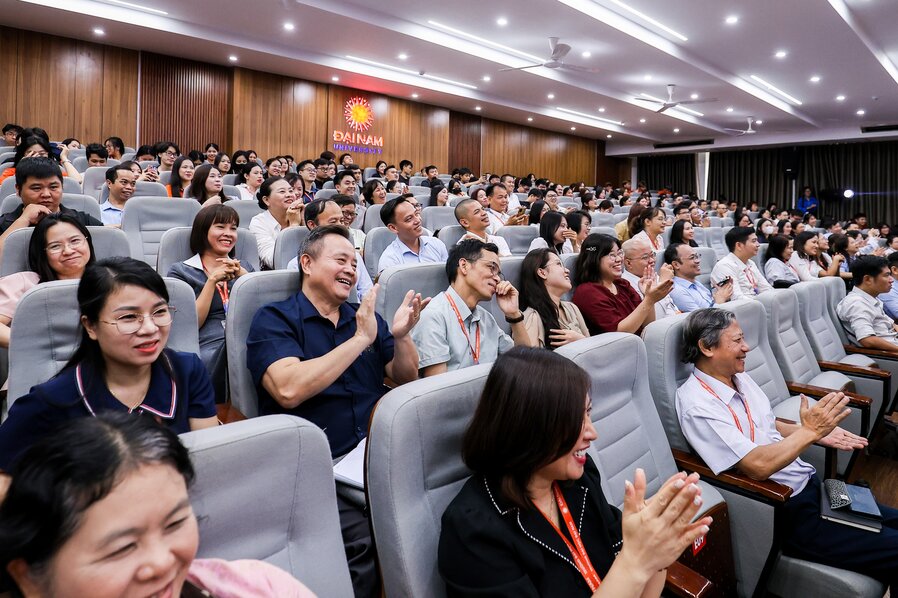
For students, Dr. Le Dac Son affirmed that at Dai Nam University, happiness does not lie in "short-term comfort" values such as easy studying, easy exams, high grades, or avoiding pressure. Instead, the university aims for long-term happiness, the core of which is helping learners achieve practical skills, independence, the ability to work, and develop professional self-respect.
"The lasting happiness of young people doesn't come from a prestigious degree, but from the confidence to stand firm on their own two feet in the face of life's challenges."
Building a happy university based on real capabilities.
According to Dr. Le Dac Son, the "happy university" model pursued by Dai Nam University is built on many elements: competency-based training, AI-assisted learning, business partnerships, and supportive discipline to help students grow.
In this approach, competency-based training is the core. The school develops output standards and designs training programs so that graduates are capable of doing the job and adapting to the real-world work environment.
According to Dr. Le Dac Son, each student needs to answer three big questions: What is the purpose of studying? What competencies do I need to achieve? and What should I be able to do after graduation?
With AI, the school's goal is to help students overcome their fear of artificial intelligence, learn how to master and use AI as a virtual assistant to improve learning efficiency, but absolutely not become dependent on it. "We don't teach students to compete with AI; we teach them to work with AI," Dr. Son stated.
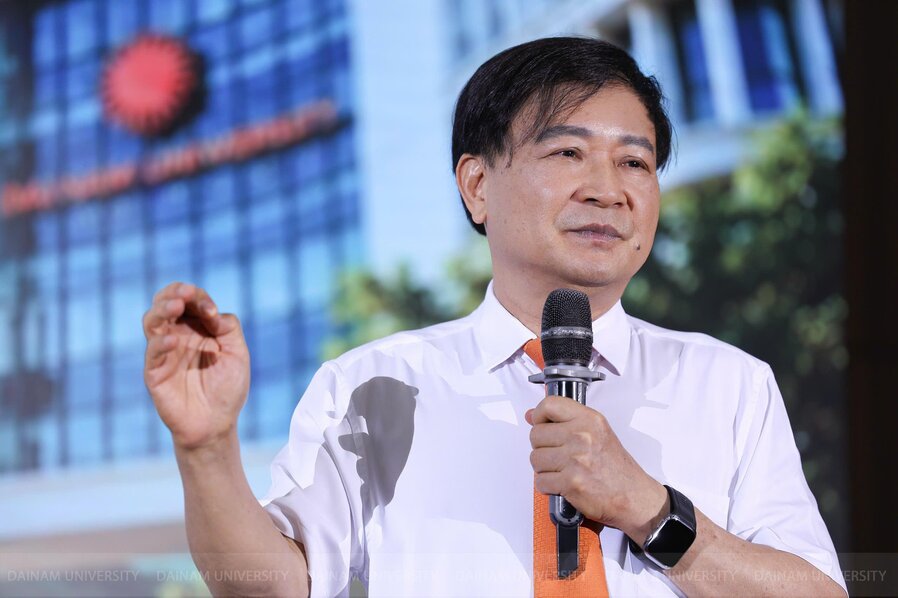
The supportive discipline is the most controversial aspect regarding its effectiveness, but he stated that Dai Nam will implement it with clear objectives, serious requirements, but always accompanied by guidance and support from teachers.
"The school does not choose laxity or leniency in management, but it also says no to formal pressure or rigid control."
In addition, businesses are also considered part of the training process, participating in developing learning outcomes, assessing competencies, and providing feedback on student quality.
According to Dr. Le Dac Son, if students have almost no exposure to the real working environment throughout their studies, it will be very difficult for them to develop practical professional skills.
Pressure is only meaningful when it helps people grow and mature.
In addition to professional knowledge, Dai Nam University also aims to train mature individuals who are self-learning, responsible, cooperative, and able to overcome failure without giving up.
One of the questions raised is: if students are required to achieve high levels of competence, study diligently, and continuously gain practical experience, will they become overwhelmed, stressed, or under excessive pressure?
Responding to this difficult balancing act, Dr. Le Dac Son argued that competency standards must be developed appropriately for each field, each stage, and in line with the students' entry requirements, but that lower entry requirements should not be justified.
"If we only build low-level capabilities based on low input, students will never be able to progress," he said.
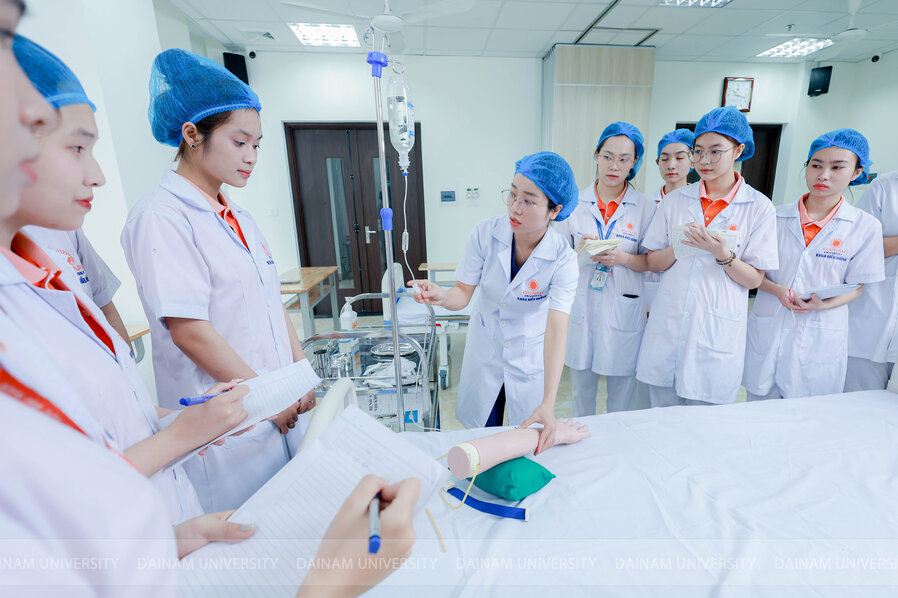
To overcome academic pressure, students need close support and guidance from instructors to avoid feeling overwhelmed or stressed.
"We always strive for a balance between studying, resting, relaxation, and academic pressure. Pressure is only meaningful when it helps people grow," shared the Chairman of the Board of Directors of Dai Nam University.
Dr. Le Dac Son shared that 19 years ago, when Dai Nam University was first established, most of its students were unable to get into public universities.
But it was precisely by daring to confront these shortcomings that the school's leadership found a way out, and today, the qualities of striving for excellence, unwavering determination in work, and the ability to adapt to the labor market of Dai Nam University students have been recognized.
Dr. Son believes that with the aforementioned model of development at Dai Nam University, the word "Happiness" is not just a marketing slogan. "A happy university cannot be created through media hype, but must be created through genuine quality and true belief," the educator emphasized.
Dr. Le Dac Son affirmed, "Dai Nam will steadfastly follow the path of building a university where every student, upon graduation, is recognized by society as a capable individual, living responsibly towards their family and country." And they will be the ones to verify the "happy university" model that Dai Nam pursues.
The workshop "Creating Happy Universities in Vietnam: From Vision to Action," co-organized by Soha.vn and Dai Nam University on May 22, 2026, is the opening event for the overall "Creating Happiness" program series, aiming to seek, spread, encourage, and honor initiatives and actions that create happiness for individuals, organizations, communities, and the country.
The workshop was attended by leaders from many universities, reputable experts, and businesspeople. 1. Dr. Le Dac Son - Chairman of the Board of Directors of Dai Nam University 2. Prof. Dr. Nguyen Van Noi - President of the Association of Vietnamese Laboratories, Former Rector of the University of Natural Sciences, Vietnam National University, Hanoi 3. Dr. Le Mai Lan - Vice President of Vingroup, Chairperson of the Board of Directors of VinUni University 4. Assoc. Prof. Dr. Tran Thanh Nam - Vice Rector of the University of Education, VNU Hanoi; Vice President of the Vietnam Association of Psychological and Educational Sciences 5. Prof. Rick Bennett - Vice-Chancellor and Vice-President, British University Vietnam (BUV) 6. Prof. Dr. Nguyen Huu Ninh - Chairman of the Management Board of the Center for Environmental Research, Education and Development (CERED) 7. Mr. Pham Huy Phong - CEO and Chief People Officer (CPO) of Mainetti Vietnam. |
Theo Soha