English
 Tiếng Việt
Dai Nam Village Festival - Springtime in the Vietnamese Soul: Bringing Young People Back to Their National Roots



There are mornings when simply stepping through a village gate erected in the schoolyard, catching a whiff of incense, seeing a pot of sticky rice cakes simmering over a fire, and a few women in traditional ao dai dresses strolling slowly in the sunlight, is enough to soften one's heart. That moment arrived on the morning of February 4th, when Dai Nam University organized the Dai Nam Village Festival - Spring Returns to the Vietnamese Soul. From then on, Tet (Vietnamese New Year) was no longer a date on a calendar or a distant memory, but a living space: one could walk through, sit down, touch, and feel. Without noise or ostentation, the village festival quietly opened up a corner of the countryside within the lecture halls, allowing young people to temporarily set aside their hurried lives and return to things that are old but dear: the hearth, the family meal, the calligraphy of the New Year – and the feeling of being in a true "village."
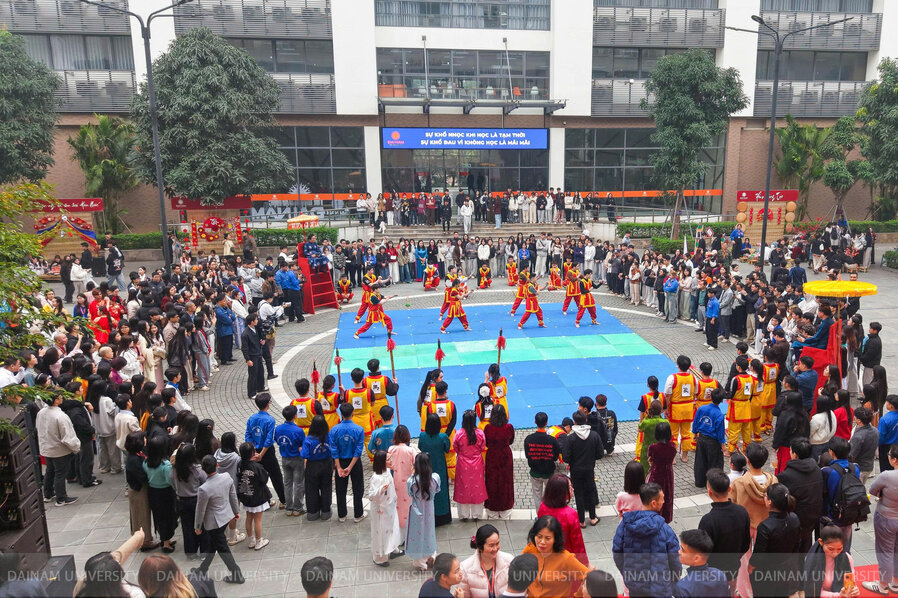
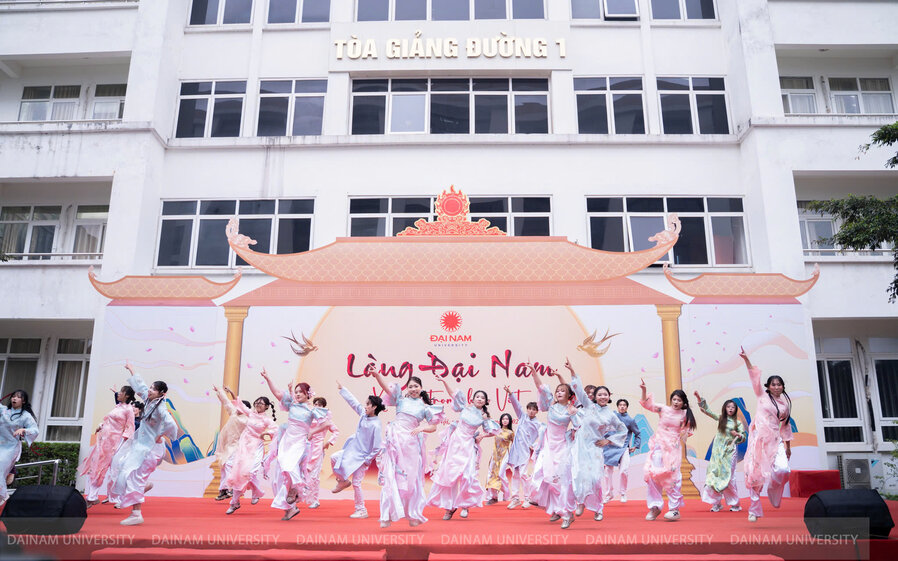
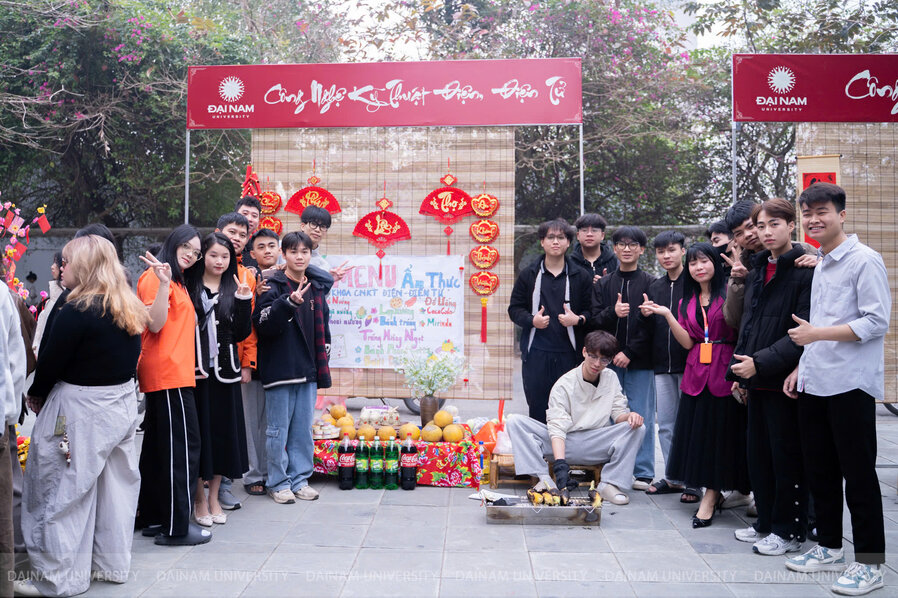
When the "village" is present in the lecture hall.
The village festival is set up like a miniature village, with "hamlets" reflecting the familiar atmosphere of Vietnamese life. Each hamlet tells a story: about love, family, memories, creativity, knowledge, and nurturing spiritual life.
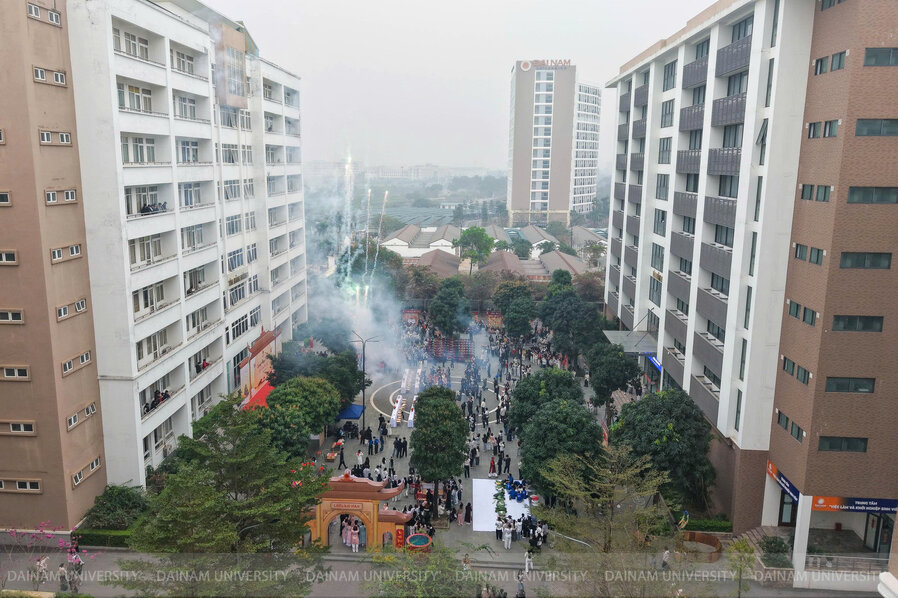
There, Tet (Vietnamese New Year) is no longer just a concept in books or a few decorative images, but something tangible, something to experience, to share, and to laugh about. Students not only "watch," but "live" in the Tet atmosphere: wrapping traditional cakes with their own hands, drawing with their own hands, playing childhood games with their own hands, and writing the first characters of the year with their own hands.
Mr. Le Dac Giang - Director of the Center for Culture and Events, Dai Nam University, shared: "The village festival is organized so that students not only learn about Tet, but also feel and live the Vietnamese Tet. Culture, therefore, is not just in slogans, but enters into every small experience, every memory that is awakened..."
Small "villages," big stories.
The "Humanitarian Village" – "The Cake of Compassion" – is always the most emotionally charged place. For over 15 years, from those pots of steaming sticky rice cakes, tens of thousands of cakes have been sent to those in need. Making these cakes is not just about celebrating Tet (Vietnamese New Year), but about sharing and giving back.
Nguyen Minh Anh, a second-year student, shared: "Every time I wrap these cakes, I realize that Tet is not just about family reunions, but also about giving. After finishing a cake, I naturally feel warmer inside."
The food village brings people back to family meals, where Tet begins with the smell of kitchen smoke, with familiar dishes, and with the feeling of sitting together and feeling complete.
The creative hub is where young people tell traditional stories in their own language: through caricatures, chibi art, workshops, etc. Culture doesn't stand still in the past, but is renewed by the imagination and hands of today's students. Tran Gia Linh, a first-year graphic design student, smiled: "I feel Tet is very close, very 'contemporary'. It turns out that tradition isn't far away at all, we just need to be willing to connect with it."
The village of calligraphers is more tranquil, filled with ink, red paper, and New Year's wishes. The calligraphy is not only for seeking good fortune, but also a reminder of the value of learning, knowledge, and character – things that stay with people for a long time and endure deeply.
The village of memories once again buzzed with laughter as people played traditional games like tò he (a type of clay figurine making), painting statues, ô ăn quan (a board game), tug-of-war, and ném còn (a ball throwing game)… Phạm Đức Huy, a first-year student, said: “Playing these games, I suddenly understood the Tet (Vietnamese New Year) of the past that my grandparents used to talk about. It’s simple, but so heartwarming.”
The "Psychology Corner" is a very gentle, very soft space. There, students can draw, chat, and reflect on their emotions. MSc. Le The Hanh – a specialist at the Psychological Counseling Center – said something very down-to-earth: When their mental well-being is properly cared for, young people will have more strength to study, to live, and to grow.
When culture is shared
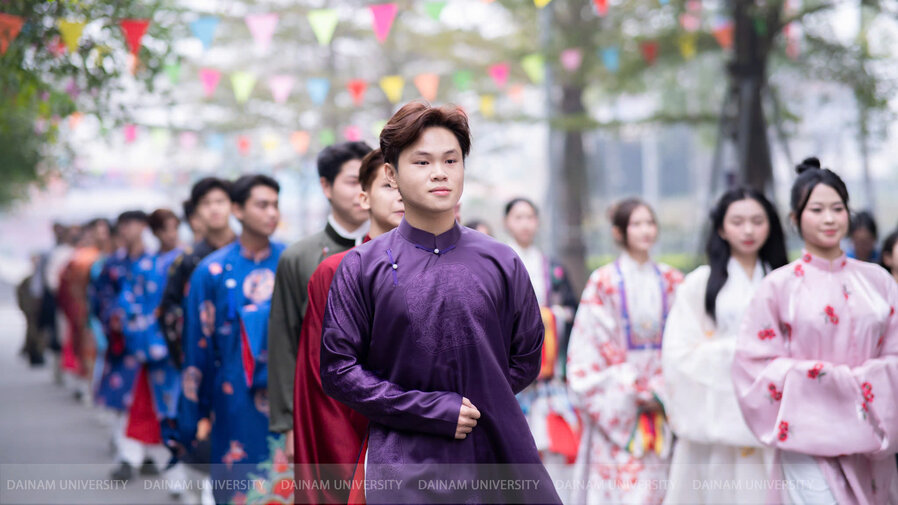
A beautiful aspect of this year's Village Festival was the sight of traditional Vietnamese costumes worn not only by Vietnamese students, but also by international students, including Indian students studying at the school. Their smiles and slightly awkward steps in traditional attire told a simple story: culture truly comes alive when shared with openness and respect.
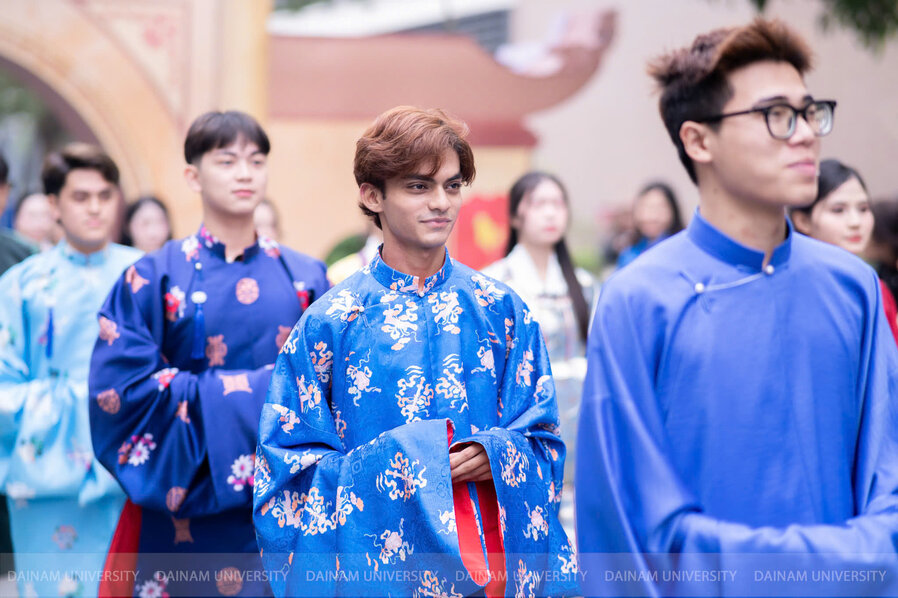
The gates of Dai Nam village, the incense village of Hue… are not just for taking photos, but for young people to “step into” the rural landscape with all their senses: seeing, hearing, smelling, touching – and remembering.
Spring is not just about flowers and cakes.
The Dai Nam Village Festival is not just a day of fun, but a way for the school to quietly provide experiential education. There, students learn to live at a slower pace, to remember their roots, and to care for others and themselves.
Spring doesn't just come from peach blossoms, sticky rice cakes, or red couplets. Spring arrives when young people understand where they come from, who they are, and carry those values with them as they continue their journey through life more steadily, kindly, and warmly.
BTT