English
 Tiếng Việt
When society is "thirsty" for skilled pharmacists: Sustainable career opportunities for young people who choose this profession with responsibility.



In the modern healthcare system, there are professions that are not flashy or in the spotlight, yet directly determine the safety of millions of people. Pharmacists are one such profession. Each pill that reaches a patient is not just a product of technology or a production line, but the culmination of scientific knowledge, professional ethics, and social responsibility. With a rapidly aging population, increasing chronic diseases, and a growing demand for healthcare, the pharmaceutical industry is facing a thought-provoking reality: society needs pharmacists more than ever, but there is a serious shortage of high-quality pharmacists. This very gap is opening up a long-term, sustainable, and prestigious career opportunity for young people who choose pharmacy as a profession with seriousness and foresight.

Society doesn't lack medicine; society lacks skilled pharmacists.
According to workforce forecasts, Vietnam will need approximately 200,000 pharmaceutical personnel by 2030. However, the current ratio of pharmacists is only about 1.19–1.2 pharmacists per 10,000 people, much lower than the actual demand. More notably, only about 19% of pharmacists hold a university degree, indicating a significant shortage of highly skilled professionals.
The rapid development of hospital systems, pharmacy chains, and domestic and international pharmaceutical manufacturing and distribution businesses is creating a vast job market. However, what the market needs most is not a large number of degrees, but pharmacists who are truly capable and competent.
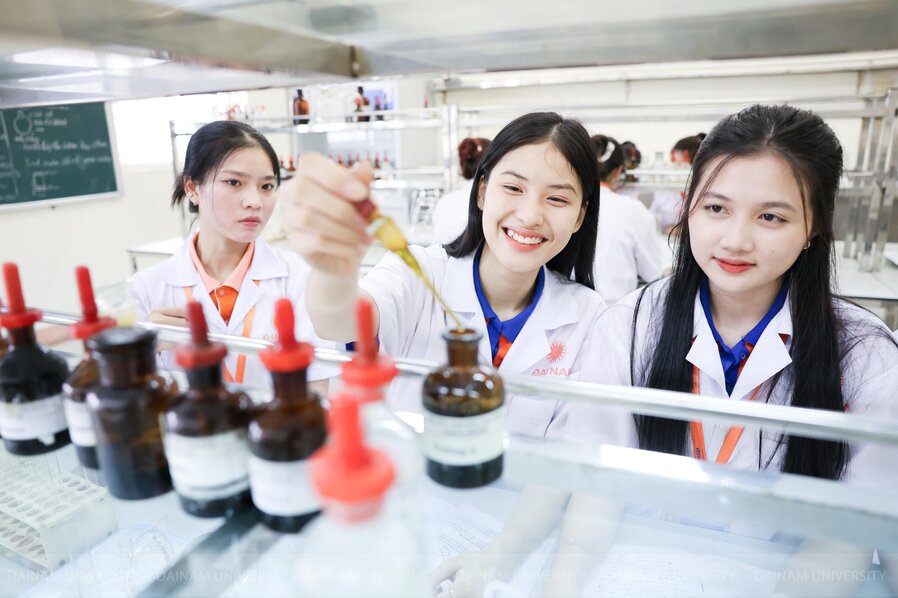
What's lacking isn't a pharmaceutical degree, but professional competence.
From a business perspective, a representative from Traphaco once shared: the current pharmaceutical market does not lack people with pharmacy degrees, but rather lacks pharmacists with in-depth expertise, strong practical skills, professional ethics, and a standard professional mindset.
The gap between "studying Pharmacy" and "working in Pharmacy" remains a major challenge for the industry. This very gap creates a clear competitive advantage for students who receive thorough, application-oriented, and integrated training. In the next 5-10 years, those who are better prepared will be the ones to move ahead – sustainably, not relying on luck.
The new generation of pharmacists: from "understanding medicine" to "mastering the profession"
The image of a modern pharmacist is no longer confined to the back of a pharmacy. The pharmaceutical job market is expanding rapidly with many specialized positions:
-Hospital pharmacist, clinical pharmacist
- Testing, formulation, research and development of drugs (R&D)
- Quality management, pharmaceutical supply chain
- Pharmaceutical marketing, pharmacy chain management
- Starting a business in the pharmaceutical and healthcare sector.

This requires pharmacy students not only to acquire knowledge but also to be skilled professionals with strong abilities, a scientific mindset, and the capacity for lifelong learning. The pharmacists of the future will be those who understand medicine, understand patients, and understand their social responsibility.
The pharmaceutical industry: a long-term career choice for forward-thinking young people.
Amidst the unpredictable fluctuations of the labor market, the pharmaceutical industry remains one of the few stable, sustainable sectors with long-term social value. This is because healthcare and medicine are essential needs, independent of economic cycles or short-term trends.
Choosing a career in Pharmacy is not simply about choosing a job to make a living, but about choosing a professional path that demands seriousness, discipline, and responsibility – a path where young people can develop their expertise, establish their position, and contribute directly to public health.

Practical training - the foundation of high-quality pharmacists.
In a society facing a shortage of skilled pharmacists, the role of training institutions becomes particularly crucial. Only standardized training programs that emphasize practical application and are closely linked to hospital and business practices can produce pharmacists who meet the demands of the modern profession.
At Dai Nam University, the Pharmacy program is developed with an applied training orientation, focusing on the learner. The program meets national accreditation standards, increases practical training time, helping students quickly develop professional skills and be ready to enter the labor market immediately after graduation.
Associate Professor Dr. Dao Thi Thu Giang - Rector shared: “DNU Pharmacy students are not only equipped with professional knowledge, but also trained in pharmaceutical ethics, professional skills, and the ability to adapt to the real working environment. These are the factors that create the sustainable value of a pharmacist in a society that is currently facing a shortage of high-quality human resources.”

The next 5-10 years: Opportunities belong to those who prepare early.
Over the next decade, the pharmaceutical industry is projected to continue facing a shortage of high-quality pharmacists. Career opportunities are abundant, and social standing is increasingly elevated – but only for those who are well-trained, truly competent, and choose the profession with a sense of responsibility.
For students and parents facing the decision of choosing a field of study, Pharmacy is not just a safe choice, but a strategic one for the future. In modern society, those who are ethical, highly skilled, and responsible to the community are always in demand.
>>> Learn more and register for admission to the Pharmacy program at Dai Nam University: [HERE]
BTT