English
 Tiếng Việt
Top hot jobs for Japanese speakers: High salaries, easy to get, global employment opportunities.



Choosing a major today is no longer just a matter of four years of university, but a decision that will shape your entire future career. Students and parents are concerned not only about "what to study," but also about finding a job after graduation, the sustainability of the profession, and whether it will be replaceable in the AI era. With Japan continuing to expand investment in Vietnam, the demand for Japanese-speaking personnel is not only increasing but also stable in the long term. Especially in the volatile AI era, jobs requiring language skills, communication, cultural understanding, and practical work experience remain difficult to replace. Therefore, Japanese is no longer just a choice based on preference. It's a safe path with many opportunities for breakthroughs, helping learners secure clear employment and adapt to a rapidly changing labor market.

Japanese language studies have become a particularly popular field among Gen Z in recent years, not only because of the novelty of the language and culture, but also because of the clear career opportunities it offers.
What jobs can you get after graduating with a Japanese language degree? Which professions are currently experiencing a shortage of skilled workers?
In fact, those who know Japanese are not limited to a specific job. The market is opening up many clear career paths, with high demand for Japanese speakers and competitive salaries.
First of all, translation and interpretation is a popular and accessible career choice. The work includes translating documents, interpreting in meetings, and supporting communication between Vietnamese and Japanese businesses. Income ranges from 15 to 40 million VND per month, higher for those with N1 level Japanese proficiency and experience. This also serves as a foundation for advancement to assistant or managerial positions.

The diverse range of career opportunities, not limited to a single path, is one of the reasons why the Japanese Language major is becoming increasingly attractive to students.
Furthermore, human resources and administration positions in Japanese companies offer stable employment and a professional environment. Employees not only need to use the language but also understand Japanese culture and work ethics to effectively manage internal operations. Typical salaries range from 12 to 30 million VND per month, with opportunities for long-term career development.
One highly valuable career path is combining Japanese language skills with information technology. IT engineers fluent in Japanese are among the highest-paid professionals, earning between 25 and 70 million VND per month. They can participate in software projects, work directly with Japanese clients, or be involved in international projects. This is a rapidly growing field with a constant shortage of high-quality personnel.
In the service sector, tourism and hospitality are also in need of a large number of personnel fluent in Japanese. The work is dynamic, providing opportunities for communication and expanding international relationships. Income ranges from 15 to 35 million VND per month, not including bonuses.
Furthermore, teaching Japanese is a suitable career path for those who love education and research. It offers stable employment with long-term career development opportunities, and an income ranging from 12 to 40 million VND per month.
Job opportunities in Japan: Expanding career paths
Beyond the domestic market, those who know Japanese also have the opportunity to work directly in Japan through engineering programs, study abroad programs, or long-term work permits.
“The Japanese market needs not only people who know the language, but also people who understand the culture and have the ability to work effectively. This is a great opportunity for Vietnamese students if they receive proper training and the right orientation…” said Mr. Nguyen Duy Anh, Principal of GAG Japanese Language Academy in Japan.
High income, a professional environment, and international experience help young people quickly improve their skills and careers.

Why is Japanese Language a worthwhile field of study?
According to experts, from a market perspective, Japanese Language Studies is not simply a language-related field of study, but a choice directly linked to career opportunities:
- High recruitment demand from Japanese companies.
- Job opportunities in diverse fields
- Competitive salary, increasing with performance.
- International and professional working environment
- Develop language skills, thinking skills, and demeanor simultaneously.
“Currently, Japanese language training cannot stop at just language skills. Students need to be equipped with professional skills, adaptability, and a mindset for working in an international environment. These are the decisive factors in their employability after graduation,” said Dr. Vu Thuy Nga, Head of the Department of Japanese Language and Culture at Dai Nam University.
Learning Japanese is therefore an investment in a global career ecosystem, not limited to a specific job position.
Where should I study Japanese to get a job after graduation?

A panoramic view of Dai Nam University at 1 Xom Street, Phu Luong, Hanoi.
At Dai Nam University (school code DDN), the Japanese Language major is designed to link training with business practice, focusing on the core objective: graduates being job-ready upon graduation.
Students not only learn the language but also receive comprehensive training in Japanese language, culture, and work ethics; simultaneously developing soft skills, an integrated mindset, and the ability to adapt to an international environment. In the context of increasingly developing Vietnam-Japan cooperation, this field of study has a high demand for human resources and offers broad job opportunities both domestically and internationally.

The Japanese Language program at Dai Nam University is designed with a clear career orientation and closely aligns with the needs of businesses.
Training program information
- Industry code: 7220209
- Training duration: 3.5 years (11 semesters)
- Admission combinations: C00, D01, D06, D14, D15, D66, X78
Highlights of the program
- Training with a clear career orientation, closely aligned with the needs of businesses.
- 100% of students receive interview support to participate in a paid internship program in Japan for 6 months to 1 year before graduation.
- 100% of students receive job placement assistance before and after graduation.
- A modern, dynamic learning environment that fosters creativity and experiences.
- A high-quality faculty team, including Associate Professors, Doctors, Masters, and experienced experts.

Representing the faculty of the Department of Japanese Language and Culture.
Clear training roadmap - capacity building year by year
Year 1: Students study beginner-level Japanese, combined with foundational modules such as Computer Science, AI, soft skills, law, and linguistics. Upon completion of Year 1, students achieve a level equivalent to JLPT N4, enabling them to communicate and work at a basic level.
Year 2: Advance to intermediate level, supplement knowledge in the field, and specialize in a particular area. Students learn a second foreign language (English/Chinese/Korean), participate in scientific research, and have the opportunity to intern in Japan (reaching a level equivalent to N3).
Year 3: Study specialized courses related to culture, economics, technology, and tourism. Continue participating in internships, research, and professional development, aiming for N2 level proficiency.

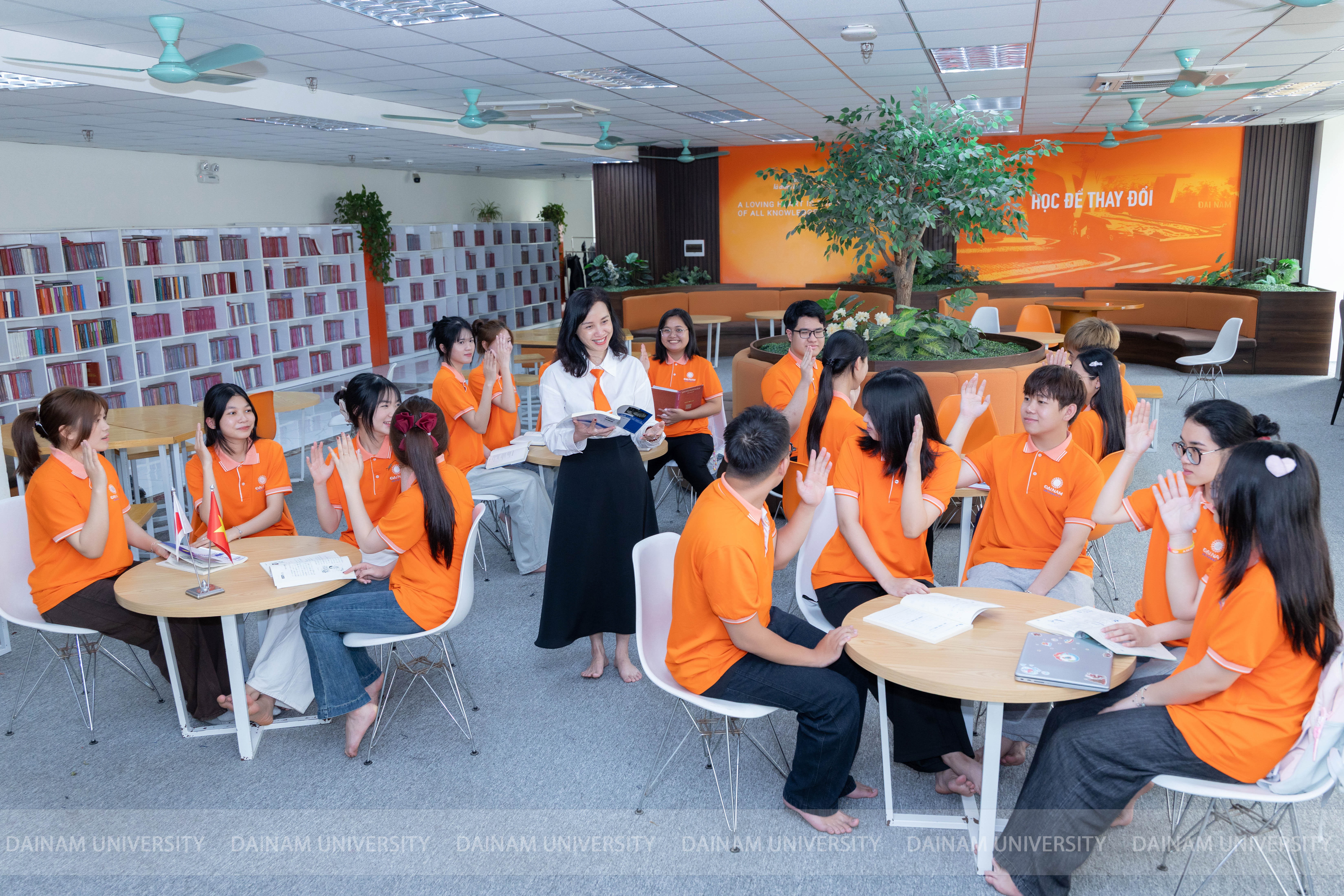
Students are trained according to a clear curriculum – improving their skills year by year.
Final year: Complete Japanese language proficiency equivalent to JLPT N2, complete a graduation internship, and be ready to work at domestic and international companies, educational institutions, research institutes, or pursue graduate studies.
With a clear roadmap closely linking learning, practice, and international experience, students majoring in Japanese Language at Dai Nam University not only acquire knowledge but also possess real professional skills to enter the labor market immediately after graduation.
Knowing Japanese is an advantage; leveraging it is a turning point.

BTT