English
 Tiếng Việt
Training engineers from the lab to the field: How Dai Nam University is preparing technology human resources for the AI era.



Artificial intelligence (AI), the Internet of Things (IoT), semiconductors, automation, and digital transformation are profoundly changing the demands for technical and technological human resources. In this context, an engineer's competence is assessed not only through specialized knowledge but also through practical skills, systems thinking, problem-solving abilities, and adaptability to new technologies. This is also why Dai Nam University is increasingly focusing on developing a training model that integrates classrooms, laboratories, workshops, and businesses.
With the guiding principle of "Open classrooms - Partnering businesses - Accelerating technology," Dai Nam University develops a training ecosystem for engineering and technology fields with an applied focus. Students gain early access to practical experience, participate in research and product development, and gradually experience the professional environment throughout their studies.
Developing an engineering mindset through practical experience.
In engineering and technology training, theoretical knowledge is the foundation for learners to understand the essence of the problem; practice is the process that helps verify, apply, and develop knowledge into competence.
An engineer needs to be able to analyze requirements, design solutions, use specialized tools, work on projects, and adapt to the rapid changes in technology. Therefore, at Dai Nam University, practical training is integrated throughout the entire training process instead of being concentrated only in the final stage.
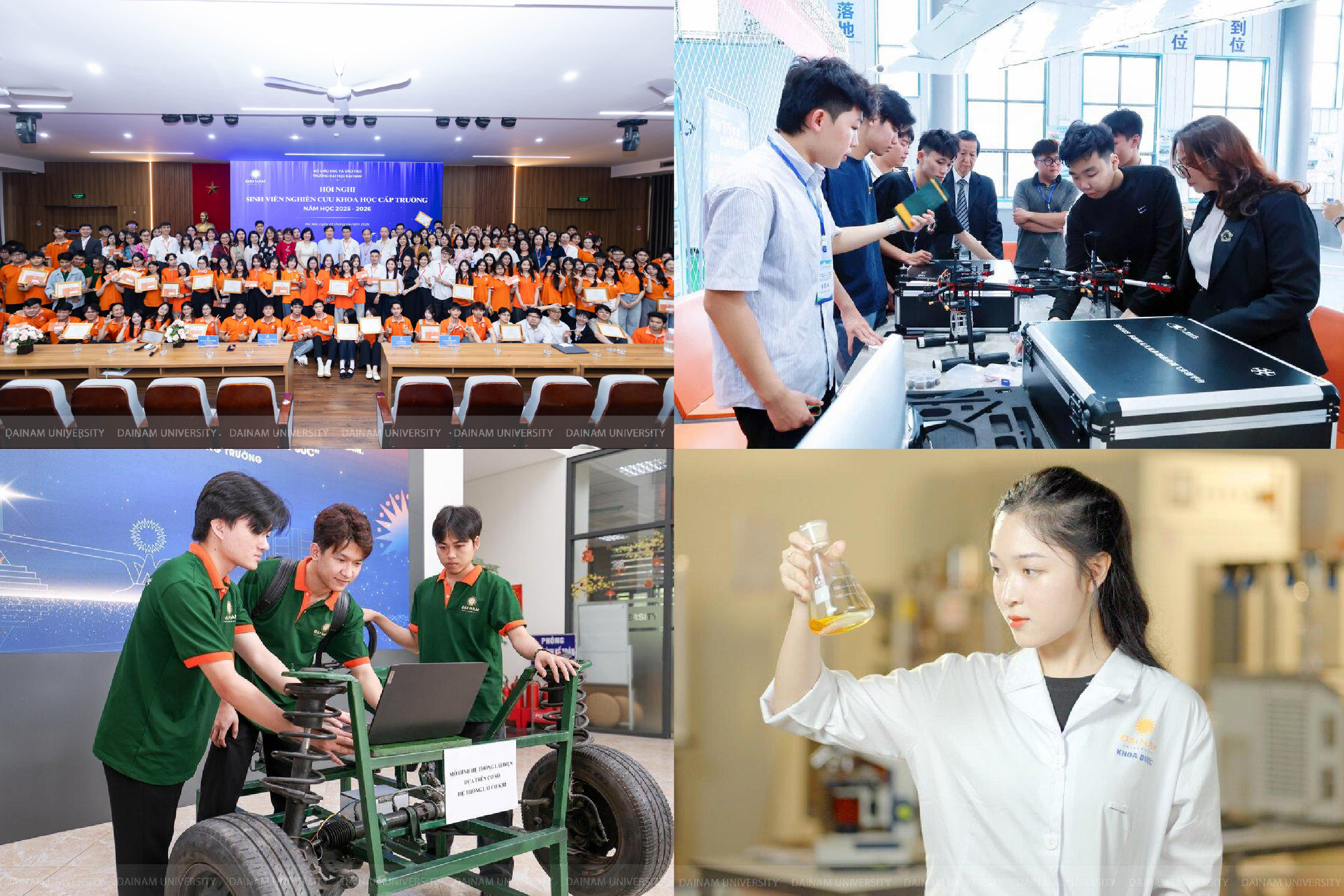
The specialized labs and workshops are organized according to the specific characteristics of each field, creating conditions for students to transform knowledge into concrete products, models, systems, or solutions. This is also an environment for learners to hone their technical thinking, teamwork skills, problem-solving abilities, and gradually develop a professional work ethic.
AIoT Lab: From Technology Research to Product Development
One of the outstanding research and practice spaces for Information Technology students is the AIoT Lab, which focuses on two highly interdisciplinary fields: Artificial Intelligence (AI) and the Internet of Things (IoT).
The lab is equipped with workstations for AI model training; IoT kits and embedded systems such as Raspberry Pi, Jetson, ESP32, and Arduino; along with sensors, AI cameras, networking equipment, and software development platforms.
On this platform, students can participate in research and development of AI models, IoT systems, intelligent robots, computer vision applications, multimodal data processing, and application solutions in smart cities, smart agriculture, and embedded systems.
The key aspect of this model is that projects, theses, and research topics are oriented towards practical applications. Through this, students gradually become familiar with the process of problem identification - research - design - testing - evaluation - product completion, rather than simply completing an academic assignment.
In addition to the AIoT Lab, students in Information Technology, Computer Science, and Data Analytics also have the opportunity to study in a system of practice rooms that support courses on computer networks, computer architecture, operating systems, and computer assembly and maintenance. Directly installing, configuring, operating, and administering systems helps students consolidate their professional knowledge and develop technology deployment skills.
Electrical and Electronic Engineering Technology and Mechatronics Engineering Technology students begin practical training at businesses in their first year.
For the Electrical and Electronic Engineering and Mechatronics Engineering fields, the practice rooms are organized into specialized groups including Embedded Systems and IoT/AI, Industrial Automation, and Mechatronics Systems.
The laboratories are equipped with specialized systems such as:
- Raspberry Pi 5 microprocessor engineering practice kit;
- CORTEX M4 STM32 Microcontroller Practice Kit;
- Power electronics practice kit;
- PLC logic controller practice kit;
- Electrical and electronic equipment practice kit;
- Industrial robots ;
- Mechatronics systems practice kit;
- Mechanical drive system.
In particular, students begin practical business experience from their first year, starting in the second semester, thereby gaining early exposure to the operations, processes, and technical problems related to their major.
Building upon knowledge of electricity, electronics, control, and mechanics, learners gradually develop the ability to design, program, operate, and apply technical systems in production.
The training process is extended to the business environment through internship opportunities at FDI companies from Japan, South Korea, China, and large domestic companies in the field of electrical and electronic equipment manufacturing and embedded systems. Some typical partners include Asia Industrial Engineering Joint Stock Company, Canon Electronics Vietnam Co., Ltd., and Brother Industrial Vietnam Co., Ltd.
Automotive Engineering Technology: Learn on the vehicle, practice in the workshop.
For Automotive Engineering Technology, the training environment is organized according to the specifics of the industry with 3 specialized workshops, each approximately 350 m² in size.
The practical training space is divided into specialized groups focusing on engines, electrical and electronic systems, and powertrain systems. Students combine theory with practical training in disassembling, inspecting, and diagnosing engines; connecting and testing electrical and electronic systems; and disassembling, inspecting, and diagnosing chassis and powertrain systems in automobiles.
The Mitsubishi Jolie and Toyota Corolla training system features operational engines and disassembled vehicle systems for component recovery and model building for training purposes. Additionally, hundreds of automotive system models are used in teaching, including those researched and built by instructors and students.
This organizational approach allows students to directly access the structure and operating principles of automobiles, while also developing skills in disassembly, inspection, diagnosis, and troubleshooting technical problems.
Career experience continues to expand through the network of dealerships, maintenance and repair garages of brands such as THACO AUTO, VinFast, Toyota, Ford, Honda, Isuzu, Suzuki, MG, as well as businesses in the transportation and automotive service sectors.
Architecture and construction: turning ideas into projects
For Architecture, Civil Engineering, and Construction Economics majors, the design practice workshop is a space for students to develop ideas, refine projects, and learn about the design process in the field of architecture and construction.
Here, specialized knowledge is integrated into the process of idea generation, plan development, and product completion. The studio-style learning environment helps learners develop spatial thinking, creativity, presentation skills, and the ability to solve design problems.
Through each project, students gradually become familiar with the professional process and practical requirements of the architecture and construction fields.
From the lab to the workplace: perfecting professional skills.
A lab or workshop only truly creates value when it is placed within a training system that links knowledge, practice, research, and business.
At Dai Nam University, students are encouraged to work in teams, implement learning projects, conduct scientific research, and develop products. For majors with a high demand for practical skills, business experience is integrated into the training process through visits, internships, and connections with businesses in each specialized field.
This model helps students gradually understand the actual work process, job requirements, and the necessary skills to adapt to the business environment.
More importantly, the learning process in the lab and workshop facilitates the development of problem-solving, analytical, experimental, evaluative, and innovative skills—skills that are of lasting importance in a constantly changing technology market.
Preparing engineers for the technology economy.
AI, semiconductors, automation, and digital transformation are creating new career opportunities while placing higher demands on technical and technological human resources. An engineer in this modern era needs to possess both a strong professional foundation and technological capabilities, creative thinking, project-based work skills, and a spirit of continuous learning.
That is why Dai Nam University continues to invest in its lab system, practical workshops, and business connections for each industry group. The goal is not only to create a modern learning environment but, more importantly, to provide students with the opportunity to develop professional skills during their studies.
The message "Unleash your identity - Illuminate your journey" is concretized through each learning experience: a practical session, a model built, an engineering problem solved, a technological product completed, or a project implemented with a company are all steps in the journey to becoming an engineer.
In 2026, Dai Nam University will enroll students in engineering and technology-related fields, including: Information Technology, Computer Science, Information Systems, Electrical and Electronic Engineering Technology, Mechatronics Engineering Technology, Semiconductor Technology, Automotive Engineering Technology, Architecture, Civil Engineering, Construction Economics, and related programs.
With its application-oriented training ecosystem, linking classrooms, laboratories, businesses, and technology, Dai Nam University aims to train engineers who not only master specialized knowledge but also possess practical skills, creativity, problem-solving abilities, and the capacity to adapt to the development of science and technology.
>>> REGISTER FOR ADMISSION: HERE
BTT