English
 Tiếng Việt
Joining the DNU Club: What do K20 students really gain after leaving it?



An event organized personally; a project directly implemented; a stage performed on; a tournament actually competed in; daring to stand in front of a crowd, lead teammates, or use a foreign language to communicate… these are the things a student can take with them when they leave a club.
And that's why at Dai Nam University (DNU), professional clubs are not just places for after-school activities, but are also oriented to become "second classrooms" - places where students go to gain practical experience and grow from real-world situations.
FROM LEARNING A TRADE TO PRACTICING IT IN THE FIELD
For a communications student, the gap between "knowing how to organize events" and "having actually organized an event" is significant.
Truong Duc Long, a Public Relations student, previously served as the Head of Event Organization for the PMI Professional Club. Drawing on his academic knowledge, Long stepped behind the scenes, directly managing programs, organizing events, and leading an organizing committee.
"Even though I'm only in my third year, I've already participated in many programs, experienced running events, organized an event myself, and led an event organizing committee in my professional club," Long shared.
After those experiences, Long gained more than just an activity to put on his CV. It was experience working with a team, handling real-world tasks, and taking responsibility for a final product.
The club, in that way, created a very concrete transition: from a student learning about a profession to a young person getting a chance to practice the profession while still in university.
FROM A COMPETITION TO REAL PROJECTS
For media students, a club might be a place to directly run a program, while for those interested in business and entrepreneurship, it could be where an idea is put to the test for the first time.
Nguyen Thi Uyen and Vu Minh Hoang, students from the Faculty of Economics & Management, were runners-up in the DBIC 2025 Digital Business Breakthrough competition. But the story doesn't end with just one award.
Following the competition, the two students were entrusted by businesses to lead two national-scale community projects. Uyen took on the "Asia-Europe Agricultural Product Export" project, aiming to introduce Hung Yen longan to the Russian and Belarusian markets. Hoang served as the project leader for "Educhic – Homeland in My Heart," connecting products, fashion, and community values through a network of students from many universities.
There's a huge difference between a competition problem and a real-world project. In a real-world project, students have to divide tasks, work with people, track progress, persuade partners, handle changes, and take responsibility for the results.
Uyen once said, "We are not just learners, but co-creators."
It's also a significant step in personal growth: from a recipient of knowledge to someone who can create products and value for others.
FROM A PASSION TO A STAGE IN FRONT OF 15,000 AUDIENCE MEMBERS
Not all students join clubs with a clear career goal in mind. Some start simply because they enjoy singing, dancing, photography, design, or performing. But a hobby, when placed in an organized environment and seriously nurtured, can also become a skill.
Le Phuong Thao, a student from the Faculty of Pharmacy, joined the DNU CREW club driven by her passion for dance. From a member, Thao became the team captain, directly involved in choreographing many major programs for the university and its faculties.
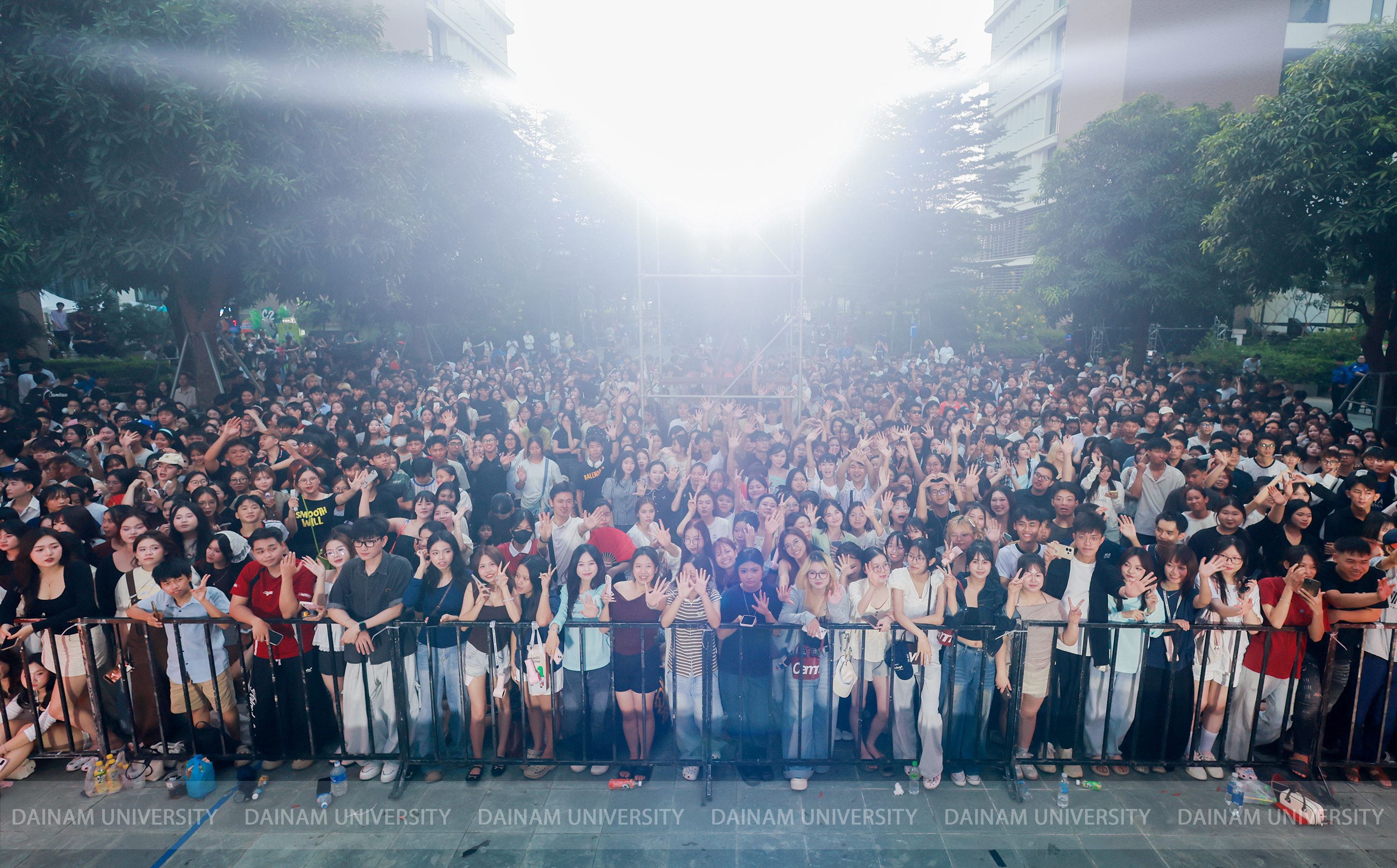
The performance by the Faculty of Pharmacy, choreographed by Thao, won the Let's Dance Season 5 championship and was subsequently performed at the Opening Ceremony and Welcome Concert for K17 freshmen in front of nearly 15,000 spectators.
Behind those few minutes on stage are days of brainstorming, rehearsing, coordinating the whole team, refining every move, and enduring the pressure of creating a collaborative product.
"A youthful and dynamic environment... is an opportunity for me to live, contribute, and fully express my talents and passions," Phuong Thao shared.
Therefore, what Thao took away from the club was not just the opportunities to stand on stage, but also the ability to organize, lead a group, work in a team, and transform her personal talent into a product that was well-received by the public.
THERE ARE LESSONS THAT CAN ONLY BE TAUGHT ON THE TRAINING GROUND.
While the stage offers students the opportunity to showcase their talent, the rehearsal stage presents a very different challenge: results don't come from a single performance, but from repeated practice.
In sports, the outcome is sometimes very clear: win or lose, move forward or stop.
At the 2024 Hanoi Youth Badminton Tournament, two first-year students majoring in Logistics and Supply Chain Management, Duong Van Tin and Duong Minh Duc, won third place. Several other DNU students also advanced deep into the singles and doubles events.
But the value of a sports club lies not just in medals. To improve, players must return to the training ground. To win, they must refine their techniques, maintain discipline, train with teammates, and learn how to bounce back after a loss.
Set goals – practice – fail – adjust – improve. That's not just the journey in sports. Later in life, it's also how a young person matures in their career and in life.
EACH CLUB CAN OFFER STUDENTS A DIFFERENT "REAL JOB"
These stories also show that there is no single formula for students to get value from clubs. Not everyone needs to do scientific research. Not everyone wants to start a business. And not every student finds themselves on the stage or in sports. The important thing is to find a suitable space to test and develop a skill they want to have.
For professional clubs, it could be a topic, a competition, a product, or a professional project. For startup clubs, it could be the first time turning an idea into a project and trying to bring it to life.
For the arts club, it could be a stage performance, a creative project, or the ability to speak in front of thousands of people. For the sports club, it's discipline, endurance, teamwork, and real competition experience.
For language clubs, the value lies not only in learning new vocabulary or grammar, but also in creating situations where students can actually use their foreign language in communication, presentations, and interactions with international students.
Everyone can choose a different path. But the common thread is: don't just participate – do something meaningful in it.
IN THE END, WHAT REMAINS IS NOT THE CLUB SHIRT.
After their college years, students may no longer remember how many club activities they attended. But they will remember an event they organized themselves; a project they completed with their teammates; a stage they were nervous about stepping onto; a game they lost but then practiced again… or the first time they dared to take on the responsibility of leading others.
These experiences gradually form a different "profile" for students - not just recorded in grades, but in the things they have actually accomplished.
Associate Professor Dr. Dao Thi Thu Giang – Rector of Dai Nam University – once emphasized: “Each professional club becomes an open learning space where students can live with their profession, work in real-world situations, and be challenged in projects that reflect real life.”
So when you join CLUB DAY, K20 students shouldn't just ask, "What's fun about this club?" Instead, ask, "What will I get to do here, and what will I become better at after a year?" Because the value of a "second classroom" doesn't lie in how many activities you participate in, but in what you actually accomplish after leaving it.
BTT